Diabetic Foot

Diabetic Foot 1

Startling Statistics

Healthy feet are essential for overall good health. For people with diabetes, taking care of their feet is especially vital. More than 60 percent of all non-traumatic lower-limb amputations worldwide are related to complications from the disease, according to the American Diabetes Association. These amputations are preventable with careful monitoring and regular foot screenings performed by a podiatrist.

Diabetes and Your Feet

While open sores on the foot—called ulcers—are the most common diabetes-related foot problem, serious conditions such as neuropathy, skin changes, calluses, poor circulation, and infection are also prevalent. The nerve damage that diabetes causes may mean a person with an ulcer or injury may be unaware of it until it becomes infected. Infection can lead to partial or full amputation of the foot or lower leg.

Diabetes Warning Signs:

  • Skin color changes
  • Swelling of the foot or ankle
  • Numbness or tingling in the feet or toes
  • Open sores on the feet that are slow to heal
  • Ingrown and fungal toenails
  • Bleeding corns and calluses
  • Dry cracks in the skin/heel
Diabetic Foot 2

Avoid Complications

Inspect feet daily.

Check your feet and toes every day for cuts, bruises, sores, or changes to the toenails, such as thickening or discoloration.

Wear thick, soft socks.

Avoid socks with seams, which could rub and cause blisters or other skin injuries.

Exercise.

Walking can help control blood sugar, keep weight down, and improve circulation. Be sure to wear appropriate athletic shoes when exercising.

Have new shoes properly measured and fitted.

Foot size and shape may change over time. Shoes that fit properly are important to those with diabetes.

Don’t go barefoot.

Don’t go without shoes, even in your own home. The risk of cuts and infection is too great for those with diabetes.

See a podiatrist.

Make at least two appointments a year with an APMA member podiatrist, the foot and ankle expert, to have your feet examined. This is a critical step in avoiding diabetic foot complications and amputation.

Fast Fact: More than 65,000 lower limbs are amputated annually due to complications from diabetes. Including a podiatrist in your diabetes care can reduce the risk of lower limb amputation up to 85 percent.

What is gout?

This week we loaded a video about a gentleman with a gout attack. People are asking, “what is gout?” According to the Mayo Clinic, ‘Gout is a common and complex form of arthritis that can affect anyone’. It’s characterized by sudden, severe attacks of pain, swelling, redness and tenderness in the joints, often the joint at the base of the big toe.

Gout occurs when our bodies either manufacture too much of a chemical called Uric Acid, or our kidneys do not eliminate enough. In both cases, uric acid levels will build up in the blood, and when it circulates, and reaches the parts of our bodies that are cooler than our core, it will cool into crystals. When these crystals end up in a joint space, it is described as sharp pins or razor blades cutting into the joint. It is extremely painful.

The big toe joint is the most common joint affected, which is why these patients come into my office. But a gout attack can actually affect any joint in the body. The attack usually comes on quite suddenly, and patients will tell me the exact minute that the pain woke them up in the middle of the night. The joint is hot, red and swollen. The patient cannot move the joint, or touch the joint, and it almost hurts just to look at it!

HOW FOODS AFFECT GOUT

When we eat food, the enzymes in our bodies break that food down to molecules that our bodies can absorb. Certain foods have uric acid as one of those breakdown products. These can trigger gout. The Arthritis Foundation has a list of foods to avoid. Once a patient is diagnosed with gout, there are medications that can be used to help our kidneys excrete more uric acid. But patients are also encouraged to work with a nutritionist to help develop a good diet that avoids these foods.

A couple of the foods that can trigger a gout attack are red meat, and any organ meats, such as liver or kidney. In the middle ages, most people could not afford such meats, which is why this disease is attributed to the wealthy class.

OUR PATIENT IN THE VIDEO

In this video, you saw x-rays that showed destruction of the joint. If the uric acid crystals are in the joint too long, as with a low-grade chronic gout situation, joint destruction is almost guaranteed. There are very specific patterns of joint destruction that can be seen with gout.

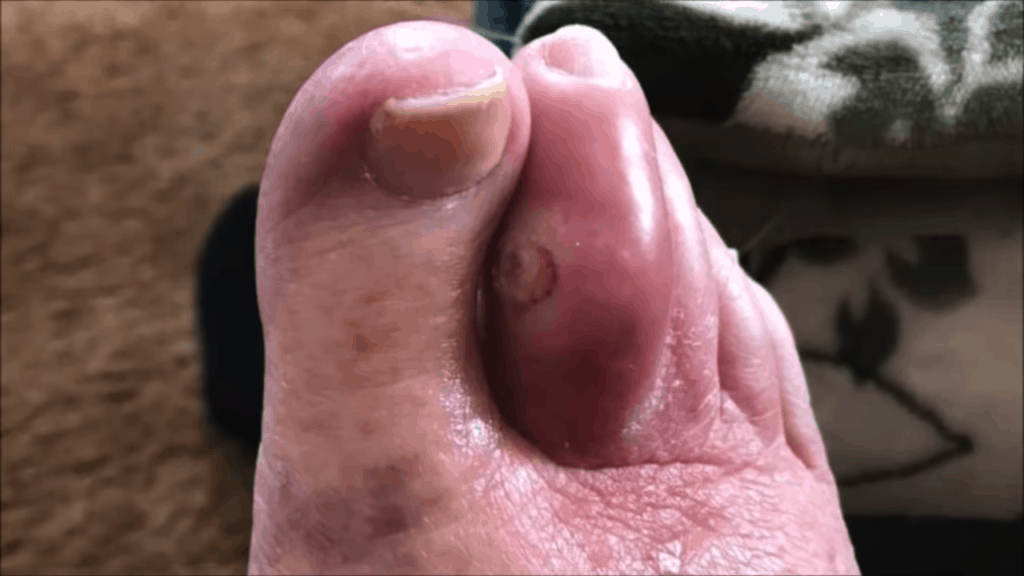
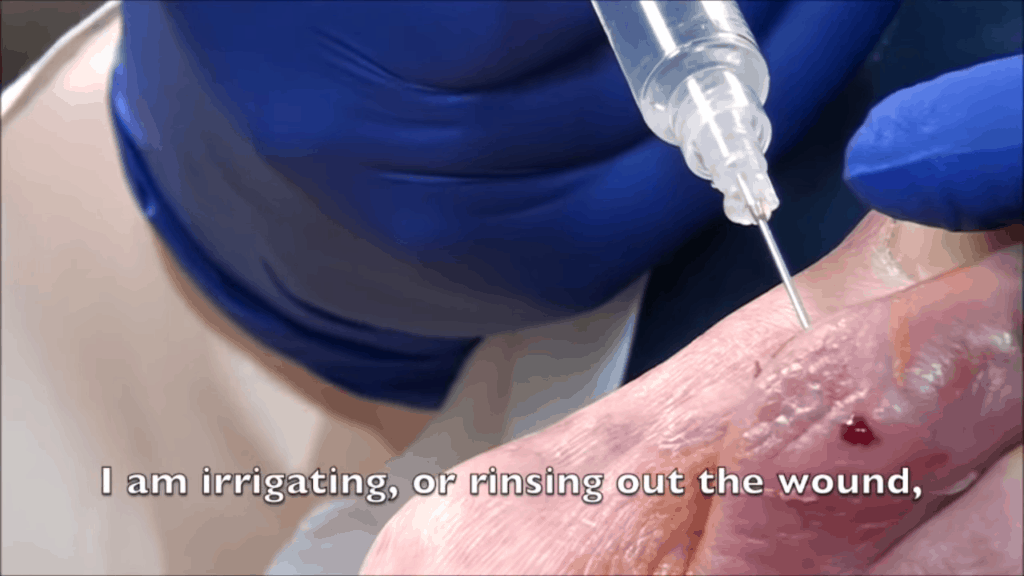
Lastly, one viewer commented that they had never seen gout drawn out of a joint like this. This patient is an exception. The large mass over his joint was fluctuant, a big word meaning “mushy”, so I knew it was filled with fluid. Usually I do not aspirate fluid from a gouty joint, as it is just too painful.

The Doc Returns, and I have a resident today.

I admire The Doc. He has been retired the whole time I have known him. However, as a Family Medicine doctor, or General Practitioner as they were known previously, he was always looking for ways to make a difference. He has told stories of traveling to India, and living there for many years, running a clinic in a rural area with his wife. One of his last projects was to start a clinic in a poorer part of our city, which has grown into a large entity that serves a large local and immigrant community. I knew the clinic long before I knew him.

The video is located here: https://youtu.be/mUwY_DjfAdA

In the video today, you hear him talk about writing a requiem that he hopes to perform, and he has already discussed with me the book he has written about trains, and the symphony he is writing. I have gone to the small hangout in South Minneapolis to hear him as he serenades diners at the Malt Shop on Monday nights. They have what sounds like a Honky Tonk piano, and he makes it sing, playing everything from Duke Ellington to Gershwin, Rogers and Hart to Rogers and Hammerstein. And the patrons love him.

You may also notice that this is the first video where I have allowed a resident to perform any procedures on a patient. I work with Family Medicine residents in their third year of residency, where they are allowed to pick up some elective rotations that interest them. This may be anything from dermatology to plastic surgery or sports medicine. They usually spend a week or so in my office. We work on the old adage of “see one, do one, teach one”. So, these are doctors in their third year of post medical school training, and many will be going to rural areas, where they will be doing basic foot care.

Every patient is asked for permission before the resident comes in the room, so that they do not feel pressured to allow the resident to work on them. I am not part of a teaching hospital or clinic, so my patients expect me to be the one to work with them. Patients are free to decline, and some do. So, I watch and supervise the first couple of patients the resident works on, helping with hand position with the instruments, etc, and then they are on their own, and I stick my head in when they’re done to be sure the patient is happy. The residents also learn to give good, pain free injections. OK, maybe not pain FREE, but injections that are a pain free as possible for numbing toes or give cortisone, etc.

The last thing I want to say about The Doc, is that we decided a long time ago that when I tried to use the cutting instruments before the sander, he walked out with too many bandages on his toes. It seems to work much better if we use only the sander. He has been quite happy with how this works for him.

Here is The Doc video’s playlist: drnailnipper.com/doc-playlist

InAlign for Bunions

They say that necessity is the mother of invention. Meet Jim, the patient in the video. He lived for many years with a bunion on the right foot that kept progressing, getting larger and larger. He had trouble finding shoes that were comfortable. Not only was the bunion bump pressing against the side of the shoe, but the hammertoe is hitting up against the top of the shoe and rubbing with every step.

InAlign for Bunions 3

To signup for more information go to: https://www.drnailnipper.com/inAlign

Jim is an architect by training and spent much of his career designing software and computer systems. He sees problems like this as an opportunity. So he set out to create a device that would hold his wayward toes in a more comfortable position. InAlign is what he came up with for his problem. He wears it in his shoes, all of his shoes, even sandals, and it is comfortable for him all day.

InAlign for Bunions 4

As he started to show friends and relatives his wonderful, comfortable device, he learned that there are quite a few people out here in the world that are also dealing with these issues. In fact, his research found that at least 25% of the adult population suffers from bunions. Twice as many women have this issue as men.

Before creating the InAlign device, he bought and used every product style available for bunions. Either the product slid around in the shoe, or was too bulky or did not allow for normal motion of the toes and foot. There were some that did not fit in the shoe at all. No product was what he was imagining in his mind, that would fit comfortably, hold the toes in proper alignment and that he could wear in all of his shoes. The prototype that you see in the video was the result of years of working with his engineer friends.

His goal is to produce this product for the mass market of bunion sufferers. To do this, he is going to turn to crowd funding. I personally have not seen any other product that does what this product can do. Remember, this is not “fixing” the bunion. Nothing will “fix” the bunion except surgery. I know there are a lot of things out there that claim they will, but they really won’t. What he is trying to do with the InAlign device is to “manage” the deformity, not “fix” it.

So, I thought it would be fun to put up a video this week that is not about toenails, but another issue that affects thousands upon thousands of people in our society. We can address other types of treatments both surgical and non-surgical in a later video. I know this sounds like a long advertisement for InAlign, and in a way it is. We want to generate interest, enough to get this product to market.

In full disclosure, I have been helping Jim create this product, along with other medical and engineering experts, because I really think it will solve many of the problems that the current items on the market do not do well. I would love to have this as an option to offer my patients.

To signup for more information go to: https://www.drnailnipper.com/inAlign

Protruding Pus from Toe

Mr. B. is our nice patient with the severe infection in the toe.  We first saw him in December, 2018, when the to was full of exudate, or pus, and we incised and drained it.  At that visit, the xrays showed that the infection had gotten into one of the toe bones.    You can see the c-shaped punched-out area on the side of the bone, in the first xray. That is bone erosion from the infection.

Check out the video here

Although the toe is looking much better now, as you can see in the pictures from his appointment in January, 2019, the xray tells another story.  A close look at the bone shows a little more of the bone has eroded.  This means the infection in the bone has progressed. 

Check out the video here

Just because the bone is infected does not mean it needs to be amputated.  The antibiotics can still work and heal the bone, but need more time.

We will take a new xray when he returns in February, 2019 and we will gladly post photos of those xrays.

Coming Soon

Dr Nail Nipper